by sig9
Hacker Wars - November 23, 2026
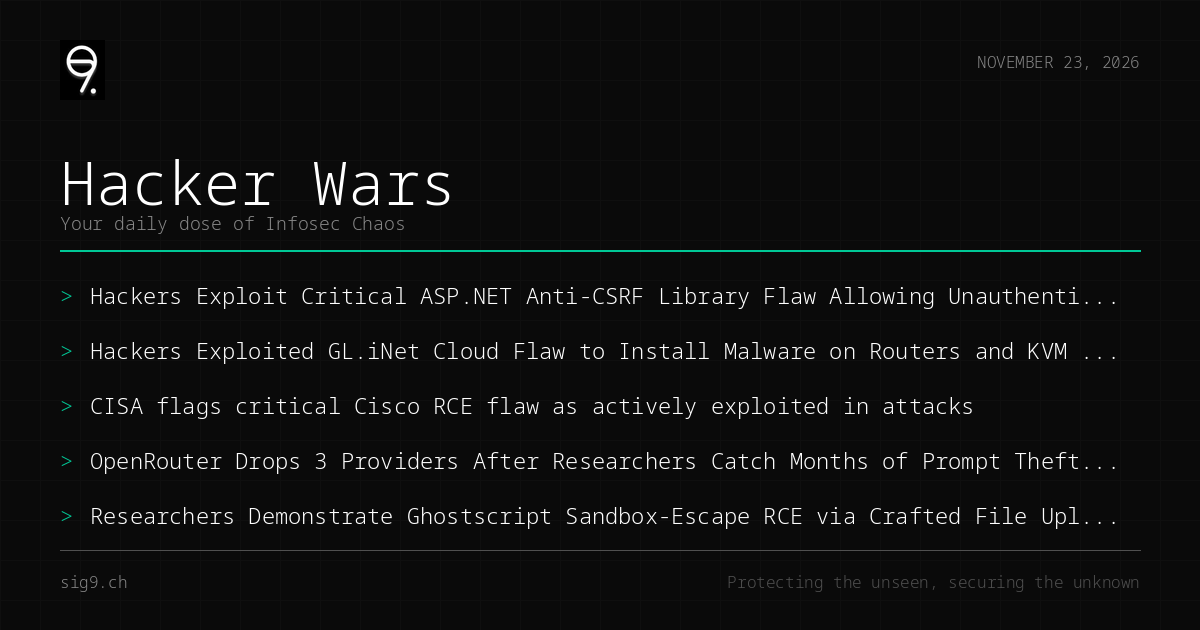
Your daily dose of infosec chaos
Two flaws are already being exploited in the wild - one in an abandoned .NET library, one in Cisco’s collaboration stack - and neither will patch itself. Meanwhile, a cloud management service got routers backdoored, AI inference providers leaked months of prompts while promising to keep none, and Ghostscript reminded everyone that file conversion is code execution. Bring coffee.
Abandoned ASP.NET Anti-CSRF Library Gives Unauthenticated RCE
A legacy ASP.NET anti-CSRF library called Idunno.AntiCsrf carries a critical flaw, CVE-2026-131914, that lets attackers run code without an account - and it is already being exploited in the wild. The library is effectively abandoned, so no patch is coming - the official advice is to uninstall it, which is a harsh sentence for a DLL quietly rotting inside decade-old .NET apps.
What to do: Hunt for Idunno.AntiCsrf.dll across your .NET estate, swap it for framework-built-in CSRF protection, and filter exploit attempts at the edge until every instance is gone.
GL.iNet Cloud Flaw Used to Backdoor Routers and KVM Devices
Attackers exploited a flaw in GL.iNet’s GoodCloud remote management service to plant malware on customer routers and KVM devices, with some victims finding backdoors and reverse shells already installed. GL.iNet fixed the flaw on Friday, but a cloud panel that manages all your devices at once is the definition of one key opening every door.
What to do: Update your GL.iNet firmware, check devices for unknown processes and outbound connections, and disable GoodCloud remote management if you do not genuinely need it.
CISA Says Cisco Expressway RCE Is Now Under Active Attack
CISA has flagged a critical Cisco Expressway remote code execution flaw as actively exploited, meaning attackers have upgraded it from “interesting bug” to “working tooling”. Federal agencies now face a patch deadline, and the rest of us get the hint: internet-facing collaboration infrastructure is always on someone’s scan list.
What to do: Apply Cisco’s patch immediately, review Expressway logs for unfamiliar admin sessions and config changes, and pull the boxes off the public internet if they do not need to be there.
Months of Prompt Theft Inside AI Hosting Providers Goes Unnoticed
Researchers found attackers had been siphoning customer prompts and completions from inside three AI inference providers for months - and none of the providers knew until the researchers rang the doorbell. Some of the stolen traffic was even flagged as Zero Data Retention, the badge that supposedly means nobody keeps your data, which is a fun way to learn what “supposedly” means.
What to do: Treat everything sent to third-party AI providers as potentially leakable, keep secrets and regulated data out of prompts, and demand real retention evidence from vendors instead of badges.
Ghostscript Sandbox Escape Turns File Uploads Into Server RCE
A now-patched Ghostscript flaw lets a crafted PDF or PostScript file escape the sandbox and run commands on the server that converts it - the classic “innocent file upload becomes RCE” chain. Ghostscript sits in the conversion pipeline of countless web apps and document workflows, frequently as a dependency nobody remembers deploying or patching.
What to do: Update Ghostscript everywhere it runs, including copies bundled inside other products, and treat every document conversion service as an untrusted-input code execution path.
That’s a wrap. Back tomorrow with more digital warfare.
Brought to you by sig9 - sig9.ch | Protecting the unseen, securing the unknown
This bulletin is provided for informational purposes. Contact us for tailored security analysis.