by sig9
Hacker Wars - November 20, 2026
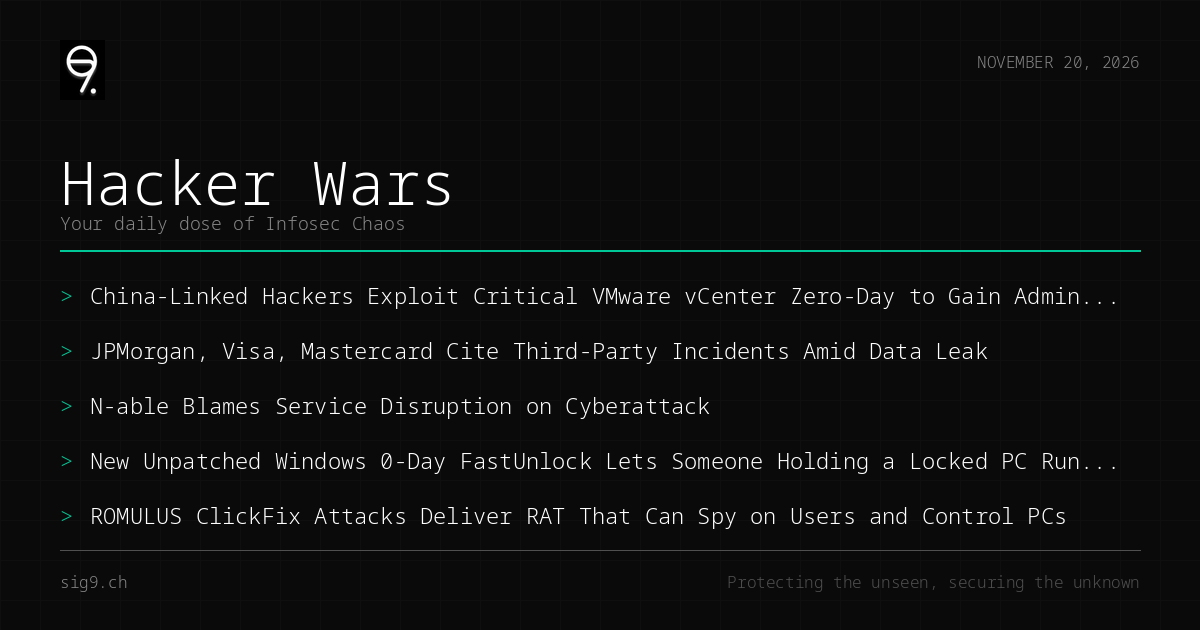
Your daily dose of infosec chaos
Two zero-days set the tone today: one has been quietly chewing through VMware vCenter since September, and a fresh Windows trick proves a locked screen is more suggestion than boundary. The third-party parade marches on with leaked data tied to major card brands and an email-security vendor blaming a cyberattack for its outage, while a malware delivery service keeps cranking out spyware. Patch early, patch often, and stop pasting commands into the Run dialog.
China-Linked Hackers Exploit vCenter Zero-Day for Admin Access
A China-nexus espionage group has been exploiting a critical authentication bypass in VMware vCenter Server since early September, riding it to full admin access and data theft - the flaw, CVE-2026-123890, sits at a comfortable 9.8 CVSS. Broadcom has shipped patches, but months of silent zero-day exploitation mean “we patched today” is already several weeks late for some estates.
What to do: Patch vCenter now, then hunt admin audit logs back to September for unfamiliar accounts, appliance config changes, and logins nobody ticketed.
Extortion Crew Leaks Data Tied to JPMorgan, Visa, and Mastercard
The N0n extortion crew dumped data it claims belongs to customers of JPMorgan, Visa, and Mastercard, and all three are pointing at third-party providers rather than their own networks. Nobody breached the banks - they breached the plumbing behind them, which is the modern playbook: why fight the vault when the contractor’s access is right there.
What to do: Inventory what customer data your vendors can reach, confirm breach-notification terms are enforceable, and treat vendor access as your own attack surface.
N-able Blames Email Security Outage on Cyberattack
N-able says a cyberattack disrupted its Mail Assure and SpamExperts hosted mail filtering, and the incident may have exposed customer credentials. When the thing that screens your email gets hit, every downstream tenant inherits the headache - and MSPs run this stack for thousands of them.
What to do: Rotate N-able credentials and API keys now, and treat recent spam verdicts and quarantines with suspicion until the investigation concludes.
FastUnlock: Unpatched Zero-Day Runs Code on Locked Windows PCs
A researcher dropped FastUnlock, a technique that lets anyone holding a locked Windows machine start programs without logging in - limited account only, no admin rights, no patch in sight. “Locked screen” was never the fortress people treat it as, and now there is a public how-to proving physical access still beats a login prompt.
What to do: No patch exists, so lean on full-disk encryption and boot passwords, and treat a locked laptop in a hotel room as exposed, not safe.
ROMULUS ClickFix Campaign Delivers New Spying RAT
The ROMULUS delivery service is using ClickFix lures - those fake “verify you are human, press Win+R and paste” pages - to push a previously undocumented RAT that spies on victims and drives their PCs. It shares code DNA with the CNCMachineRMS family and ships alongside known loaders, so this is a service, not a one-off campaign.
What to do: Train users that no website ever needs them to paste commands, and alert on browsers spawning Run-dialog or PowerShell child processes.
That’s all for now. Patch your stuff and don’t click suspicious links.
Brought to you by sig9 - sig9.ch | Protecting the unseen, securing the unknown
This bulletin is provided for informational purposes. Contact us for tailored security analysis.