by sig9
Hacker Wars - November 16, 2026
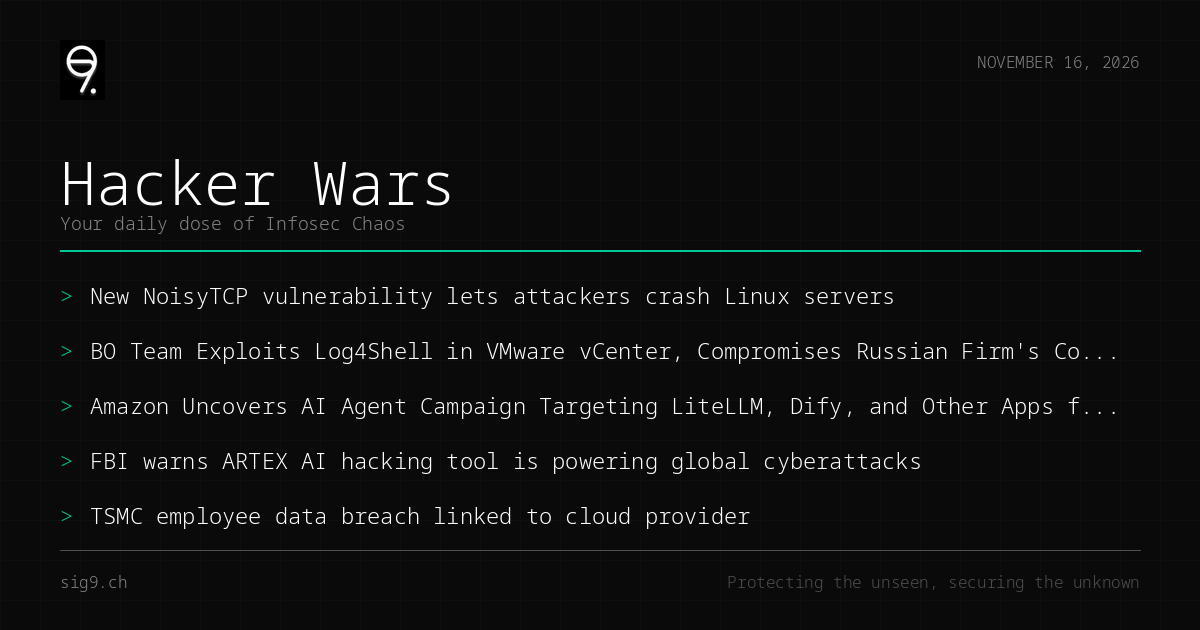
Your daily dose of infosec chaos
Today’s theme is “nothing ever really dies”: an 11-year-old Linux kernel flaw can now crash your servers on demand, and Log4Shell just notched another win against an unpatched vCenter. AI is meanwhile doing the attackers’ work for them, from hunting exposed AI apps to automating full intrusions, and TSMC found out that “the cloud provider” is the new “the dog ate my homework.” Here’s what matters and what to do about it.
NoisyTCP: Eleven-Year-Old Linux Kernel Flaw Crashes Servers On Demand
An 11-year-old Linux kernel bug, now dubbed NoisyTCP, lets remote attackers crash Nginx, Apache, and SSH servers with default configs on nearly every distro out there. It is “only” denial of service, but when the vulnerable kernel sits under your entire edge, a crash loop is just an outage with extra steps.
What to do: Track your distro’s kernel advisory and patch the moment fixes land; until then, rate-limit connections and don’t let your edge be the only thing standing between the internet and a hung box.
Log4Shell Still Pays: Espionage Crew Breaches vCenter, Grabs Code-Signing Keys
Five years after Log4j ruined everyone’s December, the BO Team crew exploited Log4Shell in an unpatched VMware vCenter to stage a months-long intrusion into a Russian software developer’s network. The prize was the code-signing server, so trojanized builds could ship wearing the company’s valid signature - the supply-chain attacker’s dream scenario.
What to do: Hunt down any surviving Log4Shell exposure on management planes, treat code-signing keys as crown jewels, and audit recently signed artifacts for anything you didn’t build.
Attackers Now Unleash AI Agents On Your AI Apps
Amazon’s decoy servers caught attacker-run AI agents probing internet-exposed tools like LiteLLM, One API, and Dify, then quietly pocketing the AI provider API keys stored inside. The best part: the agents logged their own looting, so the thieves kindly kept an inventory of stolen credentials for us.
What to do: Stop leaving AI gateways and LLM dashboards internet-facing without auth, rotate provider keys, and set spend limits before someone sets them for you.
FBI Warns ARTEX AI Pentest Framework Fuels Global Attacks
The FBI is warning about ARTEX, an AI-powered penetration testing framework that automates the grunt work of intrusion for crews worldwide - including a ConnectWise supply-chain breach that spilled into Microsoft 365 tenants. Scanning, pivoting, persistence: work that used to take a skilled operator days now runs while the attacker refills their coffee.
What to do: Patch internet-facing remote management tools fast, review third-party access to your M365 tenant, and alert on suspicious OAuth grants and inbox rules.
TSMC Confirms Employee Data Leak, Blames Cloud Provider
Chipmaking giant TSMC confirmed employee data is circulating after a threat actor auctioned 6.9GB of it, with the company pointing at a third-party cloud provider as the way in. Even the world’s most valuable fab gets reached through somebody else’s infrastructure - your vendors’ security posture is your security posture.
What to do: Map where your HR data actually lives, review subprocessor access, and put breach-notification deadlines in vendor contracts before you need them.
That’s it for today. Remember: the best incident is the one you prevented.
Brought to you by sig9 - sig9.ch | Protecting the unseen, securing the unknown
This bulletin is provided for informational purposes. Contact us for tailored security analysis.