by sig9
Hacker Wars - November 12, 2026
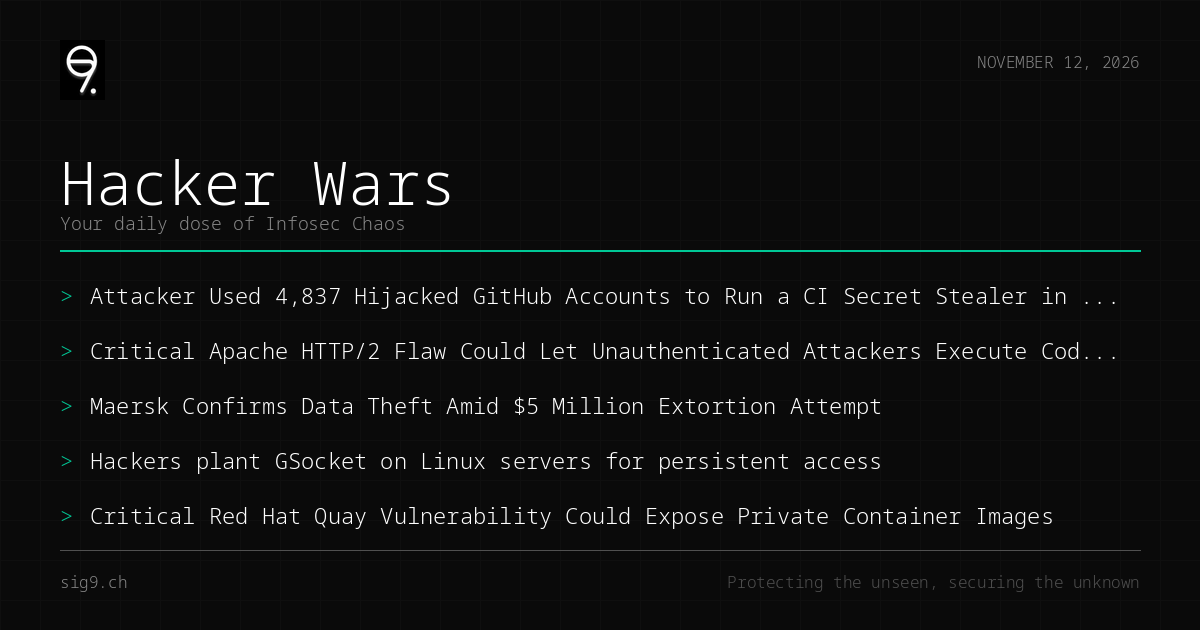
Your daily dose of infosec chaos
Today is all about the supply chain biting back: hijacked developer accounts poisoning CI pipelines, a critical Apache HTTP/2 hole that hands over the whole server, and a shipping giant getting shaken down for $5 million. On top of that, Linux intruders are refusing to leave even after you patch, and a container registry flaw could let someone rewrite your images. Buckle up - this one’s a ride.
GitHub Supply Chain Attack Plants A Secret Stealer In 1,800+ Repositories
An attacker used stolen logins for 4,837 GitHub accounts to push a secret-stealing payload into more than 1,800 repositories those accounts could write to, with the wave kicking off Tuesday. The malware hides in CI workflows and quietly siphons off the API keys, tokens, and cloud credentials that get injected during builds. This is supply-chain poisoning at scale - one reused or phished developer password turned into a credential-harvesting operation across thousands of projects, and yours could be one of them.
What to do: Rotate every CI and cloud secret, enforce phishing-resistant MFA with hardware keys on GitHub, and audit recent workflow edits and unknown commits across all your repos.
Critical Apache HTTP/2 Flaw Lets Unauthenticated Attackers Run Code Remotely
A critical bug in Apache HTTP Server’s HTTP/2 module (CVE-2026-119618) lets a remote, unauthenticated attacker execute code on the host. It affects versions 2.4.55 through 2.4.70 and is fixed in 2.4.71, but only servers with HTTP/2 enabled are exposed. Unauthenticated RCE in the most widely deployed web server on the internet is about as bad as it gets - expect scanners to be hammering this within hours.
What to do: Upgrade to 2.4.71 right now, or turn off HTTP/2 and fall back to HTTP/1.1 until you can patch.
Maersk Confirms Data Theft Amid A $5 Million Extortion Attempt
Shipping giant Maersk confirmed attackers stole data from its systems and are now demanding $5 million to keep it quiet. The WhiteArmor ransomware group claims it walked away with roughly 100GB of files. Maersk already lived through NotPetya back in 2017, so a fresh hit on a firm that moves a fifth of the world’s containers is a blunt reminder that logistics is a permanent target.
What to do: If you move freight or run logistics, treat partner and vendor access as hostile, and make sure your incident-response plan covers data extortion, not just encryption.
Hackers Plant GSocket On Linux Servers For Persistent Access
Multiple threat groups are abusing GSocket, a legitimate open-source remote-access tool, to keep a foothold in Linux servers even after the vulnerabilities they used to break in have been patched. It talks over a covert channel and looks like a normal utility, so it slips past naive allowlists. Patching the entry point no longer evicts the attacker - they are already living in your house and now they’ve changed the locks.
What to do: Hunt for unexpected GSocket binaries or processes on your Linux hosts, monitor outbound traffic to its relay infrastructure, and reimage rather than patch-and-pray once a compromise is confirmed.
Red Hat Quay Flaw Could Expose Private Container Images
A critical flaw in Red Hat Quay, a widely used container image registry, could let an attacker steal private container images, overwrite repositories, and hold onto persistent access. The registry is effectively the source of truth for everything you deploy. If someone can rewrite images there, they can push backdoored code straight into production with your own pipeline - no malware dropper required.
What to do: Apply Red Hat’s patches immediately, review registry logs for unexpected pulls or pushes, and sign your images so tampering shows up instead of blending in.
Catch you tomorrow. In the meantime, go check your attack surface.
Brought to you by sig9 - sig9.ch | Protecting the unseen, securing the unknown
This bulletin is provided for informational purposes. Contact us for tailored security analysis.