by sig9
Hacker Wars - November 10, 2026
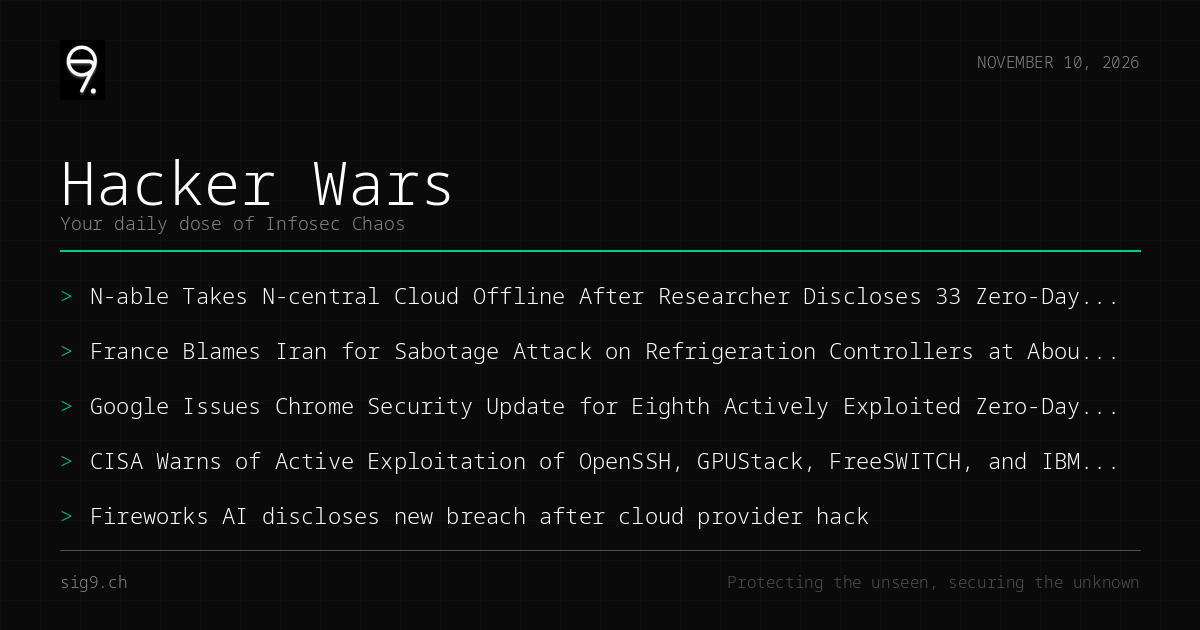
Your daily dose of infosec chaos
Two flavors of chaos today: a researcher handed the internet 33 zero-days in a remote management platform that administers entire machine fleets, and a state-backed crew decided French supermarket freezers needed heating. The everyday exploit grind keeps turning with a fresh Chrome zero-day and four flaws under active attack, while an AI startup learns the hard way what third-party access really means. Trust no appliance.
Thirty-Three Zero-Days Take An MSP Management Platform Offline
A researcher publicly dropped 33 zero-days, collectively called Able2Shell, in N-able’s N-central remote monitoring platform, complete with proof-of-concept exploits covering remote code execution, credential theft, and admin account creation. N-able pulled its hosted environments offline and told on-premises customers to shut their servers down - when the tool that administers every other machine falls over, the blast radius is your entire fleet.
What to do: If you run N-central, follow the vendor’s shutdown and patch guidance immediately, and treat every managed endpoint as unverified until you have checked it yourself.
France Blames Iran For Turning Supermarket Fridges Into Ovens
The French government says a cyber unit of Iran’s IRGC broke into refrigeration controllers at roughly 700 retail sites on the night of October 11 and rewired their defrost settings, quietly warming frozen stock across the country. Nation-state sabotage of everyday retail infrastructure is a mood, and Paris is matching it with diplomatic force: the Iranian ambassador was summoned and EU sanctions are on the table.
What to do: If you run OT or retail systems, keep controllers off the open internet, alert on config changes to refrigeration and HVAC gear, and know who would notice if your freezers started warming up.
Chrome Catches Its Eighth Zero-Day Of The Year
Google rushed out an emergency Chrome update for CVE-2026-125350, a use-after-free in the browser’s XML component that is already being exploited in real attacks. That is eight zero-days weaponized against Chrome in 2026 - the browser is the perimeter now, and drive-by compromise is clearly not a legacy problem.
What to do: Update Chrome and every Chromium-based browser your people use today, and verify that auto-update is actually working on managed machines.
CISA Confirms Active Exploitation Of OpenSSH, FreeSWITCH, And More
CISA added four bugs to its Known Exploited Vulnerabilities catalog with evidence of in-the-wild attacks: OpenBSD OpenSSH, GPUStack, SignalWire FreeSWITCH, and IBM Aspera Faspex. OpenSSH showing up on the actively-exploited list is the uncomfortable one, since it runs on nearly everything and the scanners are already at your perimeter.
What to do: Patch all four now, starting with anything internet-facing that runs OpenSSH, FreeSWITCH, or Aspera Faspex.
Fireworks AI Breach Rides In Through A Cloud Provider
AI infrastructure startup Fireworks disclosed that attackers reached its development machines after first breaching a third-party cloud provider it relied on. Dev environments hold model weights, API keys, and source code, which makes the phrase “trusted vendor” one of the most expensive in security.
What to do: Audit third-party access to development infrastructure, scope vendor credentials to the minimum, and monitor build and dev systems for unusual activity.
Catch you tomorrow. In the meantime, go check your attack surface.
Brought to you by sig9 - sig9.ch | Protecting the unseen, securing the unknown
This bulletin is provided for informational purposes. Contact us for tailored security analysis.