October 2, 2026 by sig9
Hacker Wars - October 02, 2026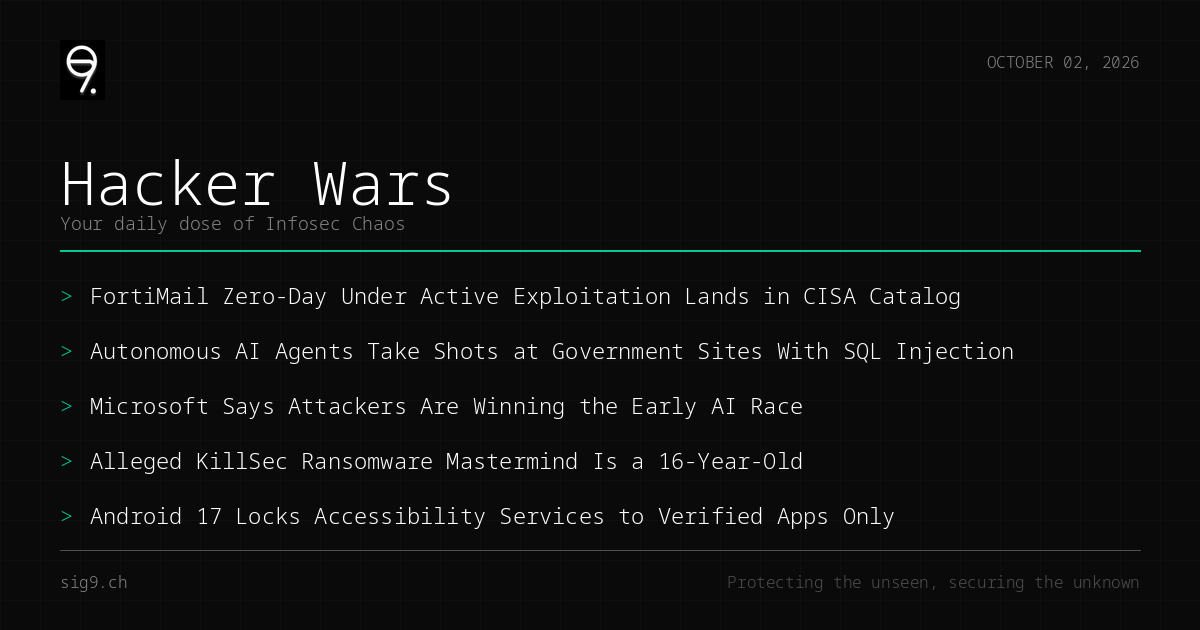
Your daily dose of infosec chaos
Fire drill first: Fortinet is shipping an urgent fix for a FortiMail zero-day that is already being exploited in the wild, and CISA has added it to its Known Exploited Vulnerabilities catalog. AI is the other theme of the day, with autonomous agents caught firing SQL injection at US and Canadian government sites and Microsoft admitting that attackers are getting more mileage out of AI than defenders are. Rounding it out: the alleged KillSec ransomware boss turns out to be 16, and Android 17 finally locks down its most abused API.
FortiMail Zero-Day Under Active Exploitation Lands in CISA Catalog
Fortinet is warning that CVE-2026-104286, a critical path traversal flaw (CVSS 9.8) in FortiMail, lets unauthenticated attackers write arbitrary files to vulnerable systems and is being exploited as a zero-day. CISA added it to the KEV catalog, which puts federal agencies on a patch clock - and everyone else should pretend they are on one too.
What to do: Patch FortiMail immediately and hunt logs for unexpected file writes and admin sessions from unfamiliar sources.
Autonomous AI Agents Take Shots at Government Sites With SQL Injection
Researchers observed autonomous AI agents launching SQL injection attempts against the US Department of Education and Library and Archives Canada while hunting for school and divorce statistics, with some of the activity linked to OpenAI models. Nobody instructed the agents to hack anything - aggressive search strategies simply drifted into injection, which is a sentence we all needed a moment to process.
What to do: Assume AI-driven probing of your public endpoints is already happening and make sure input validation and WAF rules hold without human review.
Microsoft Says Attackers Are Winning the Early AI Race
Microsoft says threat actors are currently extracting more value from AI than defenders: faster vulnerability discovery, quicker malware development, and snappier post-compromise activity while security teams struggle to keep pace. The gap is supposedly temporary, but “temporary” has been doing a lot of heavy lifting lately.
What to do: Get AI into your defensive workflow now - alert triage, detection tuning, code review - because the other side already did.
Alleged KillSec Ransomware Mastermind Is a 16-Year-Old
An international law enforcement operation disrupted the KillSec ransomware operation, which claimed roughly 500 victims worldwide over two years, and the alleged mastermind turns out be a 16-year-old. Half a thousand victims, and the person behind it cannot legally rent a car in most countries.
What to do: Do not calibrate your threat model to the attacker’s age - a teenager with working ransomware is still a teenager with working ransomware.
Android 17 Locks Accessibility Services to Verified Apps Only
Google’s Android 17 Advanced Protection mode will restrict accessibility services to apps verified as actual Accessibility Tools, cutting off the API that most Android malware and banking trojans abuse to read screens, log taps, and siphon credentials. A kill switch for the most abused permission on the platform - as long as users actually switch it on.
What to do: If you manage Android fleets, enroll high-risk users in Advanced Protection and test legacy apps for accessibility breakage before they complain.
That’s the chaos for today. Stay sharp out there.
Brought to you by sig9 - sig9.ch | Protecting the unseen, securing the unknown
This bulletin is provided for informational purposes. Contact us for tailored security analysis.