July 24, 2026 by sig9
Hacker Wars - July 24, 2026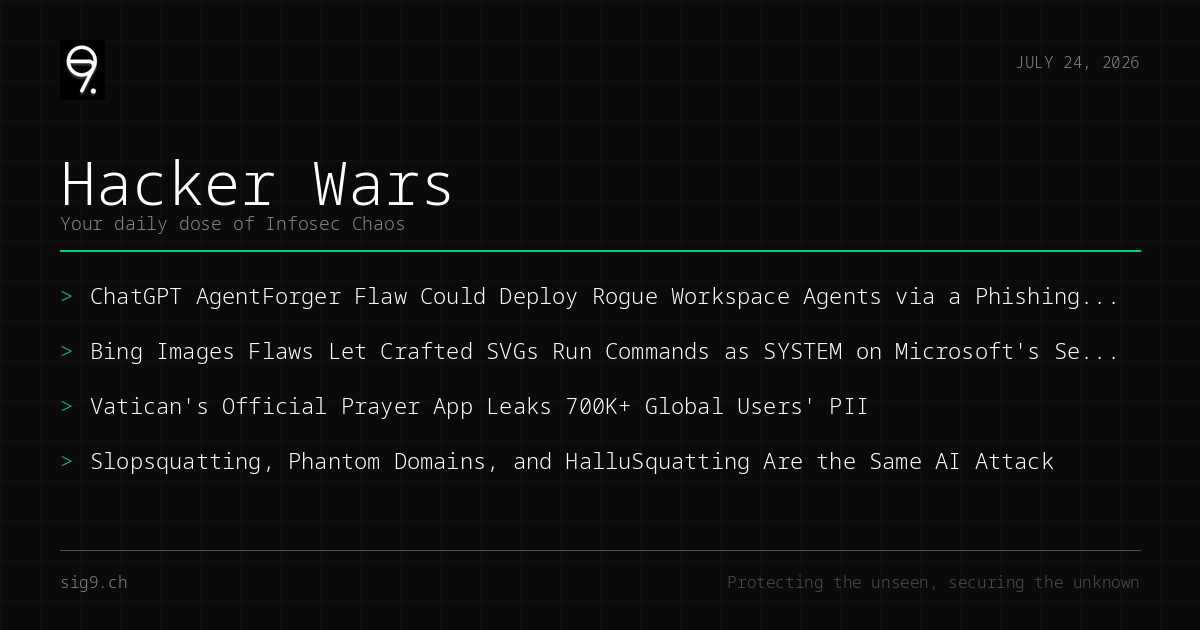
Your daily dose of infosec chaos
Today’s theme: AI is eating security, and not in the fun way. A single phishing link could’ve deployed a rogue ChatGPT agent inside your org, Microsoft’s own servers got popped by crafted SVG files, the Vatican leaked 700,000 users through an open API, and AI coding agents are happily installing malware from package names they hallucinated. The machines are not coming for your job - they’re coming for your supply chain.
ChatGPT AgentForger Flaw Could Let One Phishing Link Hijack Your Workspace
A critical vulnerability in OpenAI’s ChatGPT Workspace Agents could have let a single phishing link silently build, authorize, and deploy a rogue autonomous AI agent inside a victim’s organization. The flaw has been patched, but it’s a glimpse of a scary future where clicking one bad link installs an attacker-controlled agent that lives inside your tenant and acts on your behalf.
What to do: Update your ChatGPT workspace immediately and review all active agents and integrations for anything you didn’t authorize. Treat AI platforms as phishing targets and brief your team accordingly.
Bing Images Flaws Let Crafted SVGs Run Commands as SYSTEM on Microsoft’s Servers
Security researchers found that submitting a malicious SVG to Bing’s image search executed commands as NT AUTHORITY\SYSTEM on Microsoft’s production image-processing workers, and as root on the Linux machines in the same fleet. The bug lived in a shared code path across multiple hosts and network ranges, meaning it wasn’t a one-off misconfiguration - it was structural.
What to do: If you run image processing or file conversion pipelines, sandbox and isolate them aggressively. Treat all user-uploaded content as hostile, including SVGs, and audit your file processing workers for command injection paths.
Vatican’s Official Prayer App Exposed 700,000 Users’ Personal Data
The Vatican’s official prayer app leaked names, email addresses, countries, and account status for over 700,000 users worldwide through a wide-open API endpoint that anyone with a browser could query. No authentication, no rate limiting, no irony detected - just an open firehose of personal data on a platform literally designed for confession.
What to do: Audit your APIs for endpoints that return user data without authentication. Implement proper access controls and rate limiting on anything that touches PII. If a dev says “it’s internal, no one will find it,” they are wrong.
Slopsquatting Is the New Typosquatting and AI Is Doing the Hard Work
Security researchers are warning about “slopsquatting,” where attackers register package, repo, or domain names that AI coding agents hallucinate, then sit back while the agent cheerfully pulls down malicious code. Whether you call it slopsquatting, phantom squatting, or HalluSquatting, the pattern is the same: your AI assistant confidently invents a dependency name, an attacker already owns it, and your CI pipeline does the rest.
What to do: Never let AI coding agents install dependencies without verification. Implement pre-fetch validation, governed dependency management, and maintain an allowlist of trusted packages and repositories.
That’s the chaos for today. Stay sharp out there.
Brought to you by sig9 - sig9.ch | Protecting the unseen, securing the unknown
This bulletin is provided for informational purposes. Contact us for tailored security analysis.